
Step 1 · Day 1
Your leaders set the direction.
A two-hour session on where the company is going, how it makes money and who does what. The org chart and each role are drafted from it.
The premise
A model can read every document you own and still not know who owns a task, which process is current, which exceptions are legitimate, or where a person has to decide. That knowledge lives in your people.
Most companies keep that knowledge in static SOP documents in a shared drive, or nowhere at all. DutyGraph moves it into a living map of who does what, built to be kept current by the people who do the work, so your people and your AI work from the same understanding.
What leaders tell us
Paraphrased from our recent calls with technology and operations leaders. Names withheld.
“We sat in a room with finance for two days to write down how they work. Now we have to do it again for every team.”
“AI agents are popping up everywhere. Nobody knows who owns them or what they cost.”
“Our auditors are asking how people use AI. I can’t show them.”
Approach
A few face-to-face sessions with your leaders. Then every person works in their own app, for about 20 minutes. No workshops and no long interviews.
Step 1 · Day 1
A two-hour session on where the company is going, how it makes money and who does what. The org chart and each role are drafted from it.
Step 2 · Days 2 to 4
Each person gets their own app. In about 20 minutes they check their role, talk or type through their work, and confirm their own Task Cards.
Step 3 · Days 5 to 7
The Task Cards join into one living map of how work moves and where it waits, with a ranked list of tasks AI can help with. A person stays in charge of each one.
A department takes about seven days. A whole company takes about thirty. After that, your team keeps the map current in the same app. Durations depend on your team’s availability.
The approach in fullWhat you receive
Every number comes from your team’s own answers. You keep the readout and the files.
For everyone on the team
The app asks one thing at a time. They tap, talk for about a minute, and check the Task Card it writes. Nothing counts until they confirm it.
Every line on the map has a name and a date behind it.
For leadership
Hours a week come first, with a dollar range at one company rate. Each fix names the person who owns it, and nothing counts as captured until the owner and the sponsor both confirm it.
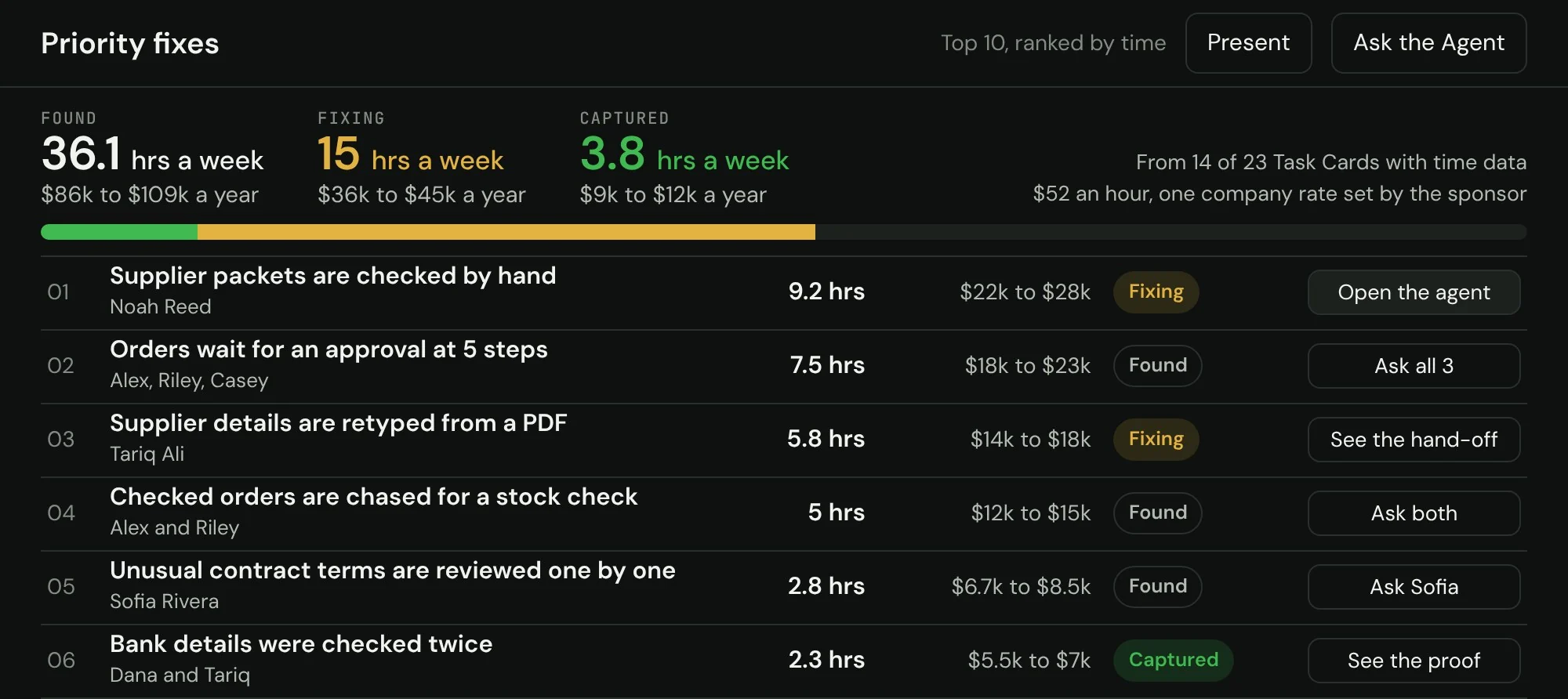
Map first. Automate second.
For the work AI takes on
An agent is drafted from the Task Card of the person who does the work, and a named person approves it. Ask the DutyGraph Agent why it did something, and it answers with its sources.
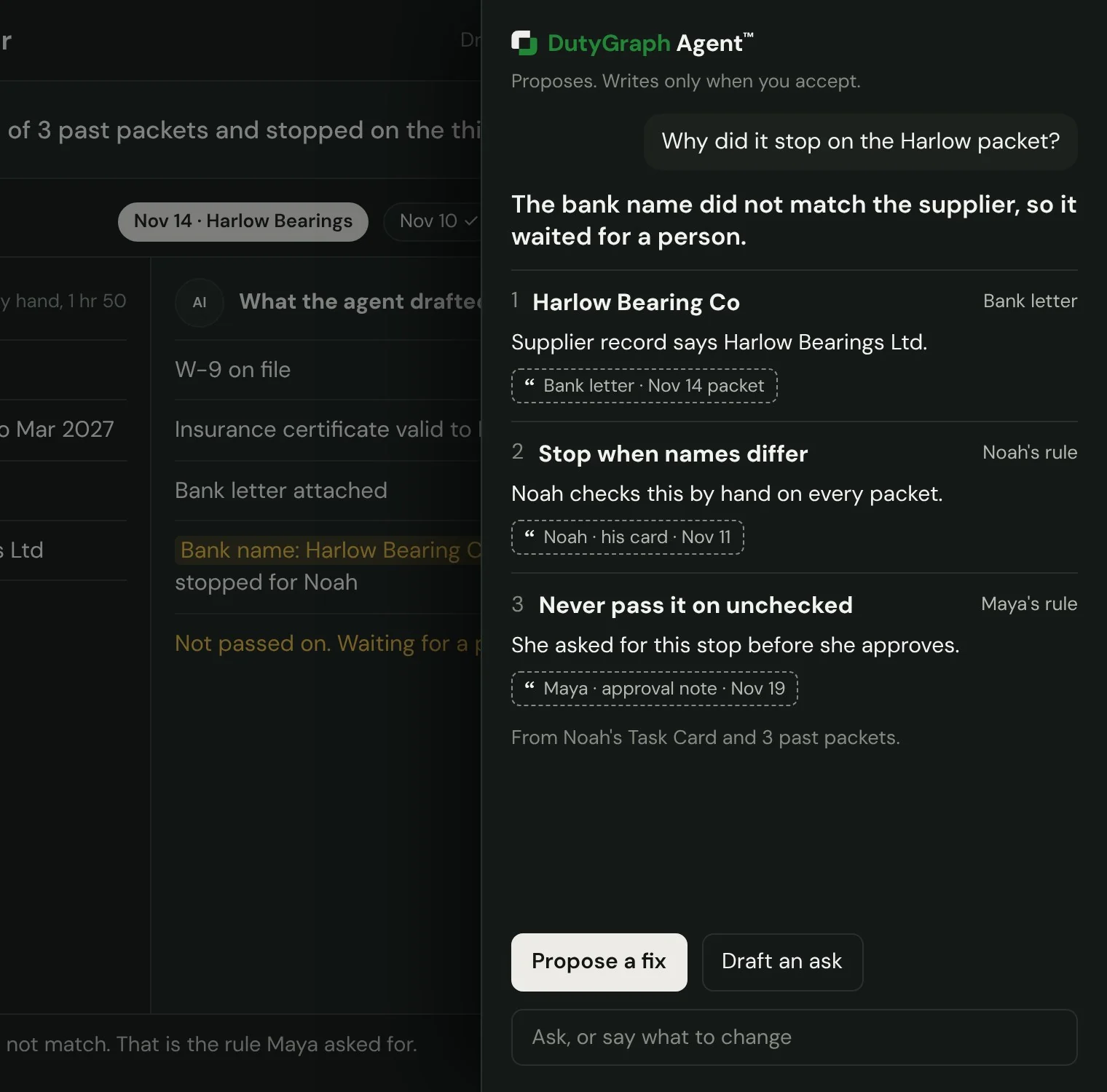
Screens shown with a fictional sample company.
Every role and duty, linked from leadership’s goals down to each person.
One card for every task, with its steps and hours, confirmed by its owner.
The hand-offs where work waits, and the tasks only one person knows.
The tasks AI can help with, in order, each with a named person in charge.
Who we work with
Engagements
Each engagement has a one-time setup, which is the first map, and a yearly plan that keeps the map current. Scope and price are agreed on a short call before anything starts.
About 7 days
For an operations leader. One department mapped: a Task Card for every task, how work moves and where it waits, and a ranked list of tasks AI can help with.
About 30 days
For a CEO or operating partner. The whole company from the CEO down: every role, duty and core process, linked to the goals leadership tracks, with a plan for the first AI work.
Scoped on a call
For large companies, acquisitions, carve-outs and roll-ups. Several business units, or both sides of a deal, mapped the same way so you can see who owns the work on Day One.
Available with any engagement: AI agent governance, which ties every agent to a named owner and keeps an approval record your auditors can export.
Engagements in detailHow we work
One session with your leaders and about 20 minutes from each person. Discovery takes days, not a season of workshops.
Your company’s context moves out of documents nobody opens and into a file system your team updates in the same app they used to build it.
AI takes the busywork. A named person stays in charge of every task it touches, and the map works with any AI your team uses.
Questions
DutyGraph maps who does what in your company, from leadership’s goals down to each person’s tasks, and keeps that map current so your people and your AI work from the same understanding. Your people keep the judgment calls.
A department takes about seven days. A whole company takes about thirty. Durations depend on your team’s availability.
No. Your leaders join one session of about two hours. Everyone else talks on their phone or types, for about 20 minutes each.
We don’t lock you into one AI company. Tools such as Claude, ChatGPT, Gemini, GitHub Copilot and any MCP client can read your map. We build each business-system connector during your project.
Every engagement has a one-time setup, which is the first map, and a yearly plan that keeps the map current. We agree the scope and the price on a short call before anything starts.
You do. Download the map and its files at any time, and for 90 days after the yearly plan ends.

Now accepting applications
Your leaders set the direction in one session. Then each person maps their own work in their own app.