
From the goals down to each task
Every role, duty, Task Card and hand-off, linked to the goals your leaders set. Each card shows who said it and whether its owner confirmed it.
How DutyGraph works
We start with your leaders, then hear from each person about their own work. Every task becomes a Task Card that the person confirms. The cards link up into one map of how work moves, where it waits and where AI can help.
Book a demoSee a sample packageOne department in about 7 days. A whole company in about 30 days.
The week
One session with your leaders, then about 20 minutes for each person. No workshops.
Process discovery
Process discovery is the work of establishing how a process actually runs today, before anyone redesigns it. DutyGraph does it by interview: your leaders set the direction, then the people who do the work describe it, and their own answers become the map. That is a different starting point from the process-mining and task-mining tools that read system logs.
Logs cannot show a workaround that happens in a spreadsheet, and they cannot say why a step exists. Interviews cannot count transactions. The two methods answer different questions, and the strongest review can combine them. Read the longer comparison: process discovery vs process mining vs task mining, or the interview questions we use.
In the app
Each work flow shows who does each step and how work moves between teams. Dashed lines are still waiting to be confirmed.
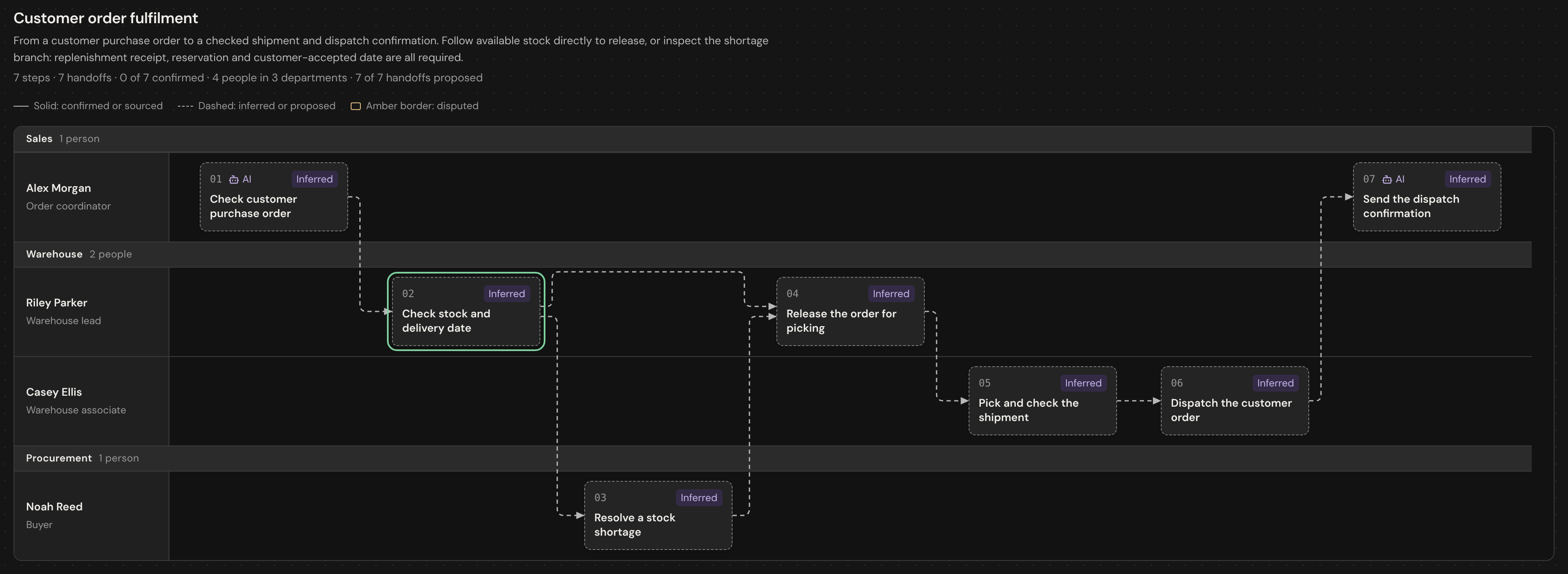
Actual app screen from the fictional Cobalt Industrial Supply sample.
What you keep
Built from your people's own words and checked by the people who own the work.
Every role, duty, Task Card and hand-off, linked to the goals your leaders set. Each card shows who said it and whether its owner confirmed it.
The same map as plain Markdown files that you own. AI tools such as Claude, ChatGPT and any MCP client can read it, with the same owners and human checks your team sees.
A ranked list of fixes and AI work, each with a named owner. Hours with AI are predictions until you measure them.
DutyGraph designs and reviews the AI work with you. It does not run agents inside your systems. After the first map, the yearly plan keeps the map current as people join, roles change and new work appears.
How pricing worksQuestions
No. Process mining reads event logs from the systems a company already runs. Interview-led discovery starts with the leaders and then the people: what they do, what they receive, what they decide and where they wait. Logs cannot show a workaround in a spreadsheet, and interviews cannot count transactions.
About 20 minutes. Each person checks the role we drafted from the leadership session, then talks about their own work on their phone or types it. They confirm each Task Card drawn from their answers. There are no workshops and no long interviews.
No. Discovery collects what people actually do. Existing documents, forms and system exports help where they exist, and anything missing is recorded as an open question instead of being filled in with an assumption.
The people who do the work. Each person confirms their own Task Cards, and on days 5 to 6 the owners check the work flows the cards link into. Each card shows who said it and whether its owner confirmed it.
They arrive in the day 7 readout as a ranked list, each one with the hours it takes today and a named owner. Your team chooses what to test. DutyGraph designs and reviews the AI work with you; it does not run agents inside your systems, and hours with AI are predictions until you measure them.
Get started
You agree the scope, plan and price on a short call before anything starts.