
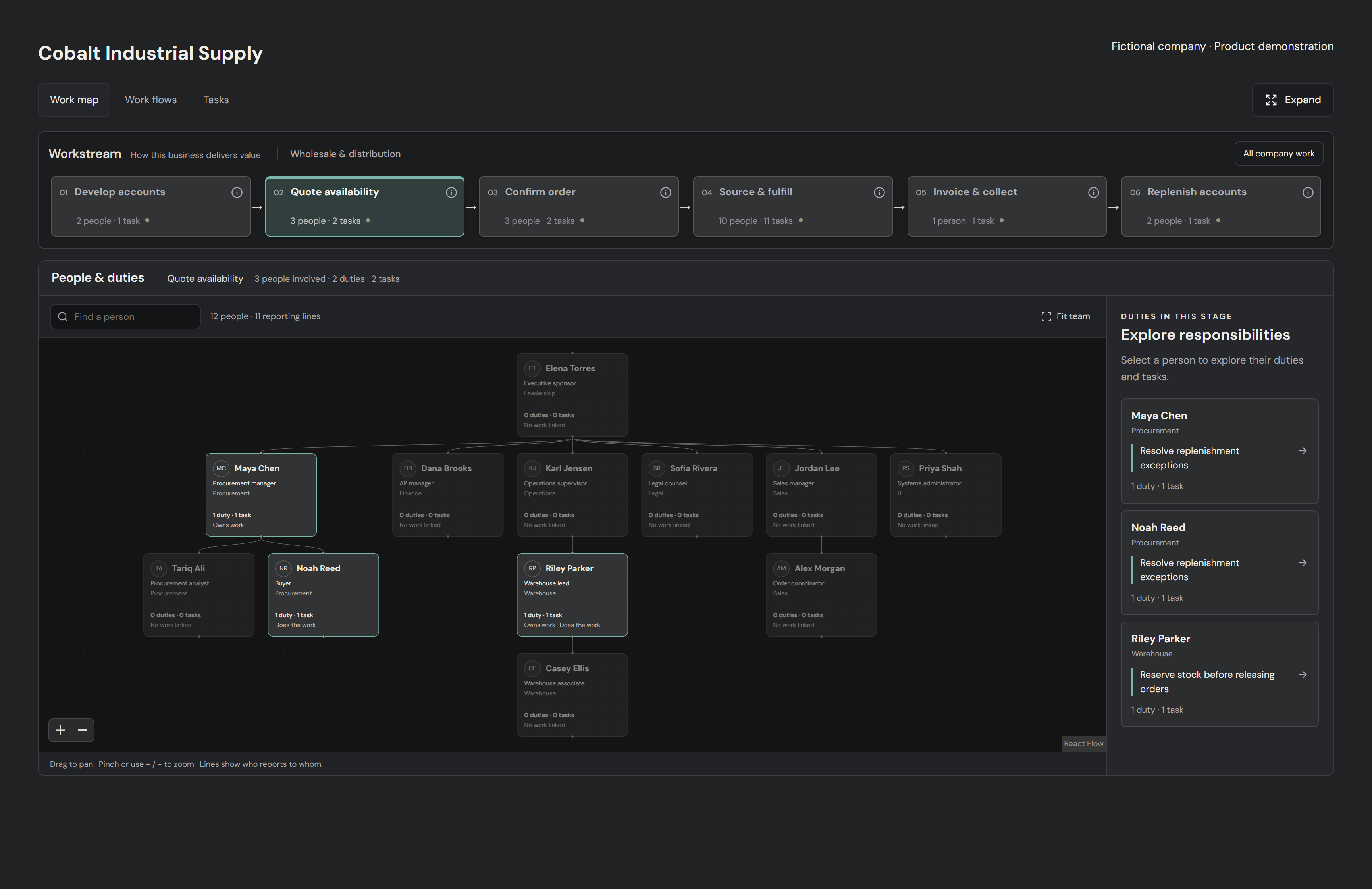
The valuable part of an advisory engagement is not copying interview notes into a diagram. It is knowing which question to ask, recognizing a disagreement and helping the client choose a sound next step.
DutyGraph is being developed to support that work. Establish context with leadership, gather private voice or text responses across the team, review the extracted duties and tasks, and bring the unresolved questions back to the right people.
Program stage: We are testing the advisor-led delivery method. Licensing, training, support, distribution and ongoing workspace terms are discussed directly; this page does not promise an established reseller program or certification.
A discovery workflow, not another transcript folder
Start by clarifying the client's goal, operating stages and scope. Review the roster and known responsibilities. Use that context to prepare participant-specific prompts rather than sending everyone the same lengthy questionnaire.
Each participant receives a private link to explain the work. They can use voice or text and check the task descriptions drawn from their response. The advisor reviews the returned accounts together, with evidence and uncertainty kept visible.
See how DutyGraph works or use the process discovery interview questions in your next scoping discussion.
Where the advisor stays essential
Leadership may describe the official process while an employee describes a workaround. Two teams may use the same label for different events. A person may perform a task without having authority to approve the result.
Software can help structure these accounts. It should not decide which account becomes company policy. The advisor establishes scope, checks the evidence, challenges unsupported conclusions and routes decisions to the appropriate owner.
The practical delivery pattern
Scope: Identify one workflow, sponsor, business question and collection boundary.
Capture: Combine leadership context with targeted participant responses and permitted documents.
Review: Check task descriptions, missing inputs, ownership and handoffs. Record disagreements instead of smoothing them away.
Read out: Present the current-state picture, unresolved decisions and possible next steps. Separate an improvement hypothesis from a measured outcome.
Maintain, when agreed: Establish who owns updates and how changes will be reviewed. Ongoing service or workspace use is a separate commercial decision, not an automatic entitlement.
What the client can receive
Agree a work map, reviewed task records, an unresolved-issues log and a next-step brief appropriate to the engagement. The operations audit checklist can help define what evidence must be present before delivery.
Do not call a diagram complete simply because it is visually finished. Make missing owners, disputed handoffs and unverified estimates visible in the readout.
What makes a useful first engagement?
A sponsor can convene the relevant people. The workflow has a clear beginning and end. Team members are permitted to explain their work. The decision is concrete enough that the resulting map can help: improve customer handoffs, reduce owner dependence or evaluate one AI use case.
The starting scope may sit within a small business or one team in a larger company. Avoid promising a whole-enterprise transformation before proving the method on a manageable workflow.
Practice before independent delivery
The existing advisor starter materials and fictional discovery walkthrough provide a place to learn the flow. Completion is not professional certification or permission to handle a client's information. Agree supervision, data access and quality review for early engagements.
Bring one workflow you know well
Tell us what kind of advisory work you do, how you currently collect process information and where client participation is hardest. The goal is to test whether DutyGraph improves the delivery method, not simply adds another application.