
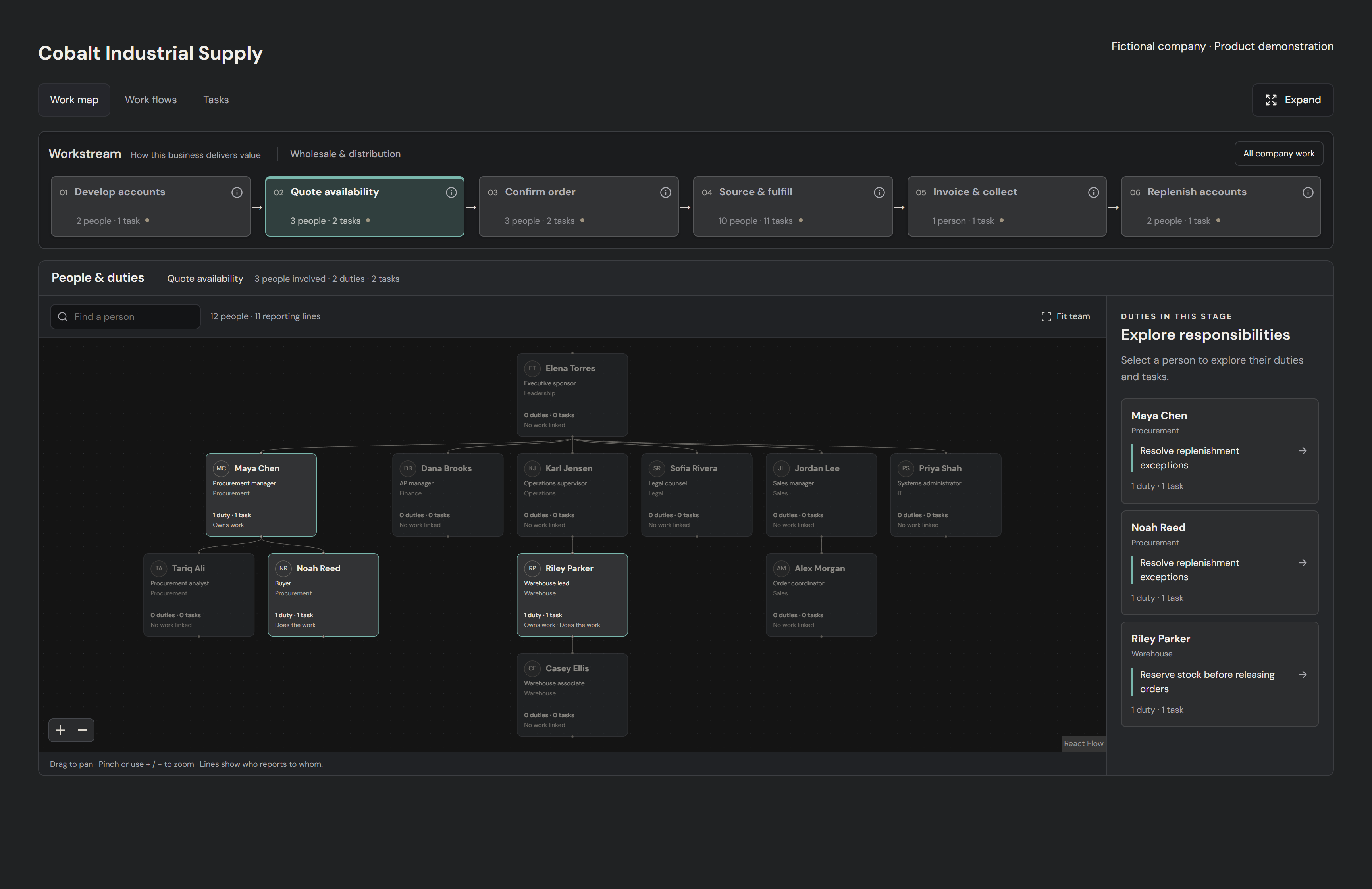
A business operations audit is a structured review of how work really gets done in your company. It is for owners, COOs and operations leaders. You get a map of people, roles, duties, tasks, software and handoffs, the places where work waits, and a ranked list of what to fix first.
How it starts: one department in about 7 days, or the whole company in about 30 days. Scope, participants, fees, timing and data-handling terms are agreed on a short call before work begins. An inquiry does not commit you to anything.
What does a business operations audit cover?
It covers what starts each piece of work, who performs it, what information they need, where it changes hands, which software they use and how the result is checked. It is not a financial statement audit, a tax review, a legal opinion or a compliance certification. It is also not a promise to find a set amount of savings.
Every number in the readout comes from the team's own answers. A reported delay is not yet a measured delay, and the brief says so where supporting records are missing.
Where does an operational assessment usually start?
You do not need a finished process diagram. Bring a situation you can recognize:
- Customer commitments keep getting lost between sales and delivery.
- Routine exceptions come back to the owner because nobody knows who can decide.
- A critical process depends on one experienced employee.
- Teams re-enter the same information in different systems.
- Leadership wants to use AI but cannot identify a sensible first task.
Start by understanding the business and its main areas of work. Then use a concrete example, such as an accepted quote becoming an order, to investigate the details. For a large organization, agree the departments to include first.
How does the review work?
Set the direction with leadership. In a session of about 2 hours on day 1, we work with your leaders on where the company is going, how it makes money and who does what. Each role is drafted from that session. Leadership's description is a starting hypothesis, not a substitute for employee evidence.
Hear from the team. On days 2 to 4 each person checks their drafted role and talks about their own work, by voice or by typing, in about 20 minutes. They review the task descriptions drawn from their answers. Nobody has to write a polished procedure first.
Reconcile the differences. On days 5 to 7 we link the task records into one map, the people who do the work check it, and we follow up on unclear ownership, separating reported work from approved policy. Live conversations stay available when a disagreement or a sensitive issue needs one.
Choose the next decision. The readout separates findings, open questions and proposed improvements. Sometimes the next step is a process change. Sometimes it is better documentation, clearer responsibility, a system connection or one bounded AI experiment.
See how DutyGraph discovery works.
Is a business process audit the same thing?
A business process audit looks at one workflow end to end: the trigger, the steps, the decisions, the exceptions and the accepted result. An operations audit is wider. It looks across the departments that share those workflows, so you can see which process to examine first.
This page covers both. A scoped engagement can concentrate on one process, or start with the whole business and then open up the process that matters most. When the main need is a detailed current-state workflow, use process mapping services.
What do you get at the end?
Agree the exact outputs in the engagement scope. A scoped audit can work toward a current-state work map, linked people and task records, a list of unresolved handoffs or responsibilities, and a prioritized next-step brief.
Ask for the evidence behind each finding. A proposed saving is not realized value. Where supporting records are unavailable, the brief should say what still needs to be collected. For a preview of the questions, use the business operations audit checklist.
How long does a business operations audit take?
We reply within 1 business day. A one-department audit runs about 7 days: a 2-hour leadership session on day 1, each person checking their role and talking about their work on days 2 to 4, then the map, the team check and the readout on days 5 to 7. The whole company takes about 30 days.
How much does it cost?
The scope and the price are agreed on a short call before anything starts. The factors that move both are the workflow boundaries, the number of participants, the business units involved, the evidence already available, the sensitivity of the information and how much reconciliation the accounts need. See how pricing works.
Does the audit have to end in an AI project?
No. An operations audit can also surface tasks that may deserve an AI or automation experiment. A useful candidate has a clear purpose, reliable inputs, an identifiable owner, reviewable outputs, manageable exceptions and a human checkpoint where judgment still matters.
The next action may instead be clearer responsibility, better process documentation, a system integration or a conventional automation. Read how to identify automation opportunities for the test we apply.
A practical example
Illustrative, not a customer result: Sales says an order is ready once the quote is accepted. Operations says it cannot begin until delivery details and the approved configuration arrive. Finance is waiting for the customer's billing information. Everyone completed their local step, but the handoff has no shared acceptance rule.
The useful finding is not "the team needs more automation." It is that "ready" means different things to three teams. The next action is to agree the required information and the receiving owner, then measure whether rework declines.
Which assessment do you need?
Choose process mapping services when your immediate need is a detailed current-state workflow. Use the AI opportunity review in this audit when you need to compare candidate tasks before selecting tools. An AI readiness assessment asks whether a chosen use case has the operating conditions needed for a responsible first AI project.
Common questions
Do we need our process documentation before we start?
No. Existing SOPs, forms and system records help, but incomplete documentation is not a reason to delay. The audit collects what people actually do and records what is still unknown instead of inventing the missing steps.
Will our team have to sit in workshops?
No. Each person answers a few questions about their own work, on their phone or by typing, in about 20 minutes. Live conversations are used only where a disagreement or a sensitive issue needs one.
Who sees what our employees say?
The people running your engagement, and the person who gave the answer. Answers are reviewed by the person before they are sent. Scope, retention and data-handling terms are agreed before the work starts; see privacy and measurement.
Can you audit more than one department?
Yes. Most companies start with one department so the first readout arrives quickly, then add departments once the method is proven inside the business.
What does being a design partner mean?
Design partners get a scoped audit at an agreed price and help shape the product. In return we ask for honest feedback on the method and the readout. DutyGraph does not publish customer names or results without written permission.